


у Запоріжжі
Road signs are a means of organizing traffic
Road signs are means of organizing traffic, which are standardized graphic drawings that convey certain messages to road users.
We offer services for the production of road signs: triangular road signs (1.1-1.2; 1.3.1-1.3.2; 1.5-1.28; 1.32-1.39; 2.1), round road signs (3.1-3.30; 3.33-3.43), square road signs (5.8-5.23; 5.25-5.27; 5.29-5.30; 5.36-5.38), rectangular road signs 1050*700 (5.16-5.17; 5.19), rectangular road signs 1050*350 (5.16-5.17; 5.19), rectangular road sign 1400*700 (5.16-5.17; 5.19), rectangular road sign 2250*500 chevron (5.16-5.17; 5.19), plates 700*350 (7.1.1), octagonal road signs (7.1.1).
Additional information signs or signs for road signs
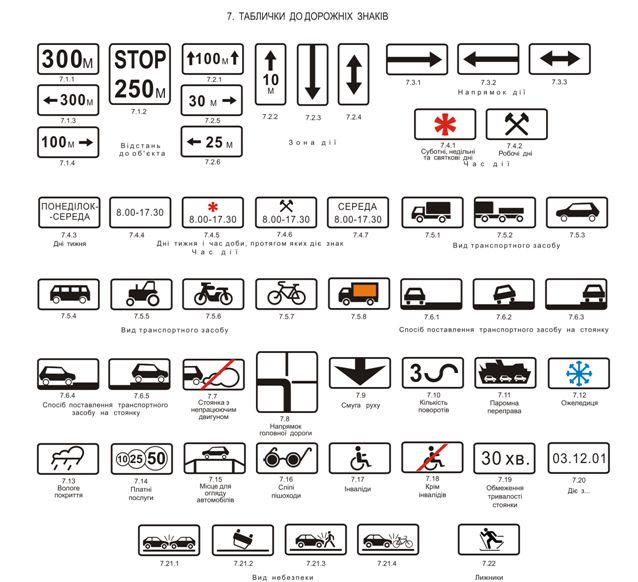
Additional information signs (or signs for road signs) are special rectangular signs that are installed together with the main road sign and clarify its effect.
Service road signs
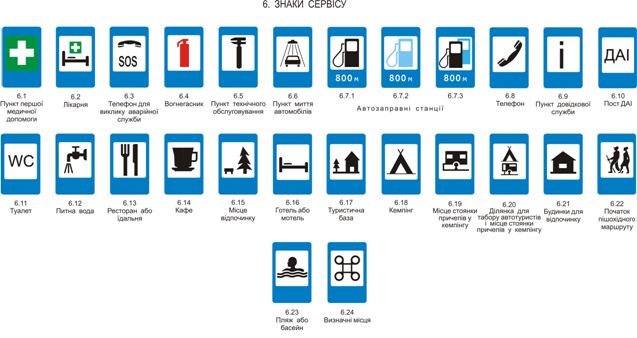
Service road signs are a subgroup of information and direction signs that inform drivers and pedestrians about the location of service, rest and assistance facilities on the road.
Information and direction road signs
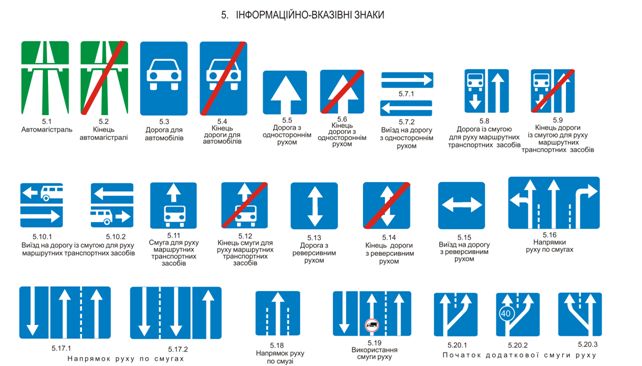
Information and direction road signs are a group of road signs that provide drivers and pedestrians with useful information about the road, traffic routes, service facilities and traffic organization features.
They do not prohibit or prescribe actions, but rather orient and assist road users.
Mandatory road signs
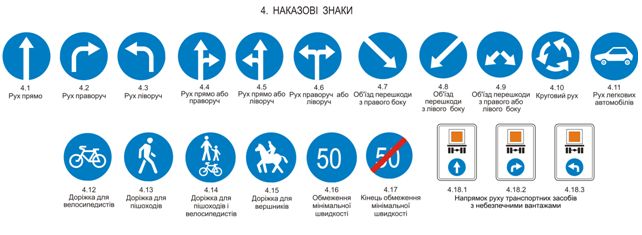
Mandatory road signs are a group of road signs that establish a mandatory direction of travel or a required course of action for drivers. They do not prohibit, but on the contrary, they prescribe what exactly the driver must do.
Prohibitory signs
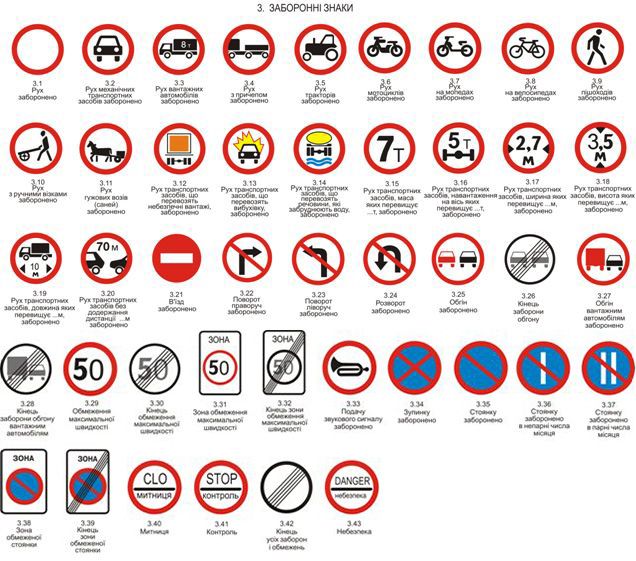
Prohibitory signs are a group of road signs that introduce restrictions or completely prohibit certain actions of road users. They are mandatory for execution, and violation of their requirements entails administrative liability.
Priority signs

Priority signs are a group of road signs that indicate the severity of the intersection, narrow sections of the road, and the place where the trajectories of the flow of transport vehicles change.
Their main task is to determine who has the upper hand in Russia, and who is guilty of compromising the road.
Warning signs
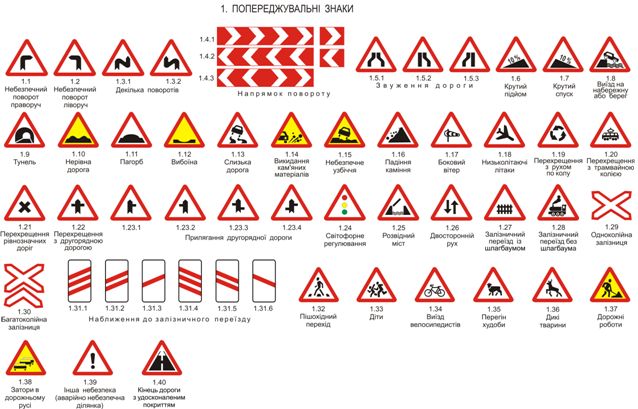
Warning signs should warn in advance of a possible threat so that the driver can slow down, be more attentive and, if necessary, take measures for safe driving
The process of making road signs
The process of preparing road signs includes a decal of stages. axis
- Design: It is necessary to develop the design and the draft of the road sign. This includes the designation of the form, rozmіrіv, kolorіv, symbols and the text, as in support of the normative documents.
- Choice of material: Various materials are used for the preparation of road signs, such as galvanized steel, plastic and composite materials. The choice of material to lie down was able to reach the value, durability, visibility and varnosti of the mark.
- Preparation of the substrate: The substrate of the traffic sign, usually a flat surface, must be prepared before applying the reflective film. This may include cleaning and painting the surface to ensure good adhesion and durability of the road sign.
- Graphics and Text Application: Graphic, symbols and text are digitally printed onto the surface of the reflective film. Special paints are used, which provide good resistance to external influences.
- Testing and Quality Control: Finished signs are tested to ensure they meet regulatory requirements. Quality control includes checking dimensions, colors, visibility and other parameters to ensure that the mark is correct and reliable.
- Installation and placement: After production, road signs are installed on roads in accordance with the requirements and rules specified in regulatory documents.
Norms and standards used in the manufacture of road signs
In Ukraine, the norms and standards for the manufacture of road signs are regulated by state regulations. Below are the main norms and standards that are used in the production of road signs in Ukraine:
- GOST 12.4.026-76 "Road signs. General technical requirements" - this standard defines the general requirements for road signs, including their design, materials, dimensions, colors, application methods and other technical parameters.
- GOST 12.4.027-76 "Road signs. Types and main sizes" - this standard establishes the types and main sizes of road signs, including triangles, circles, rectangles and other shapes.
- DSTU 4159:2003 "Road Signs. General Vimogi" is a national Ukrainian standard that defines general requirements for road signs, including their shape, dimensions, colors, types of materials and technical characteristics.
- DSTU 4012:2001 "Transport. Road signs. Wimogi to backgrounds, colors, albums" - this standard defines the requirements for backgrounds, colors and albums used in the manufacture of road signs in order to ensure good visibility and distinguishability of signs for drivers.
- DSTU 4275:2003 "Transport. Road signs. Materials for the production of road signs" - this standard defines the requirements for materials used in the manufacture of road signs, including types of materials, their physical and chemical properties.
In addition to these standards, there are also regulations and guidelines issued by the relevant authorities and institutions of Ukraine that regulate the placement and use of road signs on the roads.
Важно отметить, что стандарты и нормы могут изменяться и обновляться со временем, поэтому мы регулярно обращаемся к актуальным и официальным документам, выданным компетентными органами, для получения точной и свежей информации о требованиях к изготовлению дорожных знаков в Украине.
The history of road signs
The first mention of road signs dates back to Ancient Rome, where stone pillars with carved directions and city names were used. They helped travelers navigate and choose the right path. However, such signs did not provide information about traffic rules or dangers.
In the Middle Ages, signs and guide plates for travelers appeared in Europe, indicating the distance to cities and main places. However, they also did not have a systematized system of signs and were not associated with certain traffic rules.
The first road signs similar to modern ones appeared in the second half of the 19th century in Great Britain. In 1868, the first enameled metal signs were erected in Liverpool to regulate traffic. These signs warned of dangers, indicated traffic rules and speed limits.
At the beginning of the 20th century, the development of the automotive industry and the increase in the number of cars led to the need to improve the system of road signs. In 1909, the United States developed the first system of road signs, consisting of triangles, circles and rectangles of various colors. This system became the basis for subsequent developments and was implemented in many countries.
In 1949, the International Commission on Road Traffic (ICDD) was established, which standardized the system of road signs and developed uniform rules for their use. This was an important step towards ensuring safety and consistency on the roads between different countries.